


Pitch Estimation in Real Time: Revisiting SWIPE with Causal Windowing

Peter Meier, Sebastian Strahl, Simon Schwär, Meinard Müller, Stefan Balke
This website is related to the following publication:
- Peter Meier, Sebastian Strahl, Simon Schwär, Meinard Müller, and Stefan Balke
Pitch Estimation in Real Time: Revisiting SWIPE with Causal Windowing
In Proceedings of the International Symposium on Computer Music Multidisciplinary Research (CMMR): 285–297, 2025. Details Code DOI@inproceedings{MeierSSMB25_RealTimeSWIPE_CMMR, author = {Peter Meier and Sebastian Strahl and Simon Schw{\"a}r and Meinard M{\"u}ller and Stefan Balke}, title = {Pitch Estimation in Real Time: {R}evisiting {SWIPE} with Causal Windowing}, booktitle = {Proceedings of the International Symposium on Computer Music Multidisciplinary Research ({CMMR})}, pages = {285--297}, address = {London, UK}, year = {2025}, doi = {10.5281/zenodo.17496630}, url-details = {https://audiolabs-erlangen.de/resources/MIR/2025-CMMR-RTSWIPE}, url-code = {https://github.com/groupmm/real_time_swipe} }
Abstract
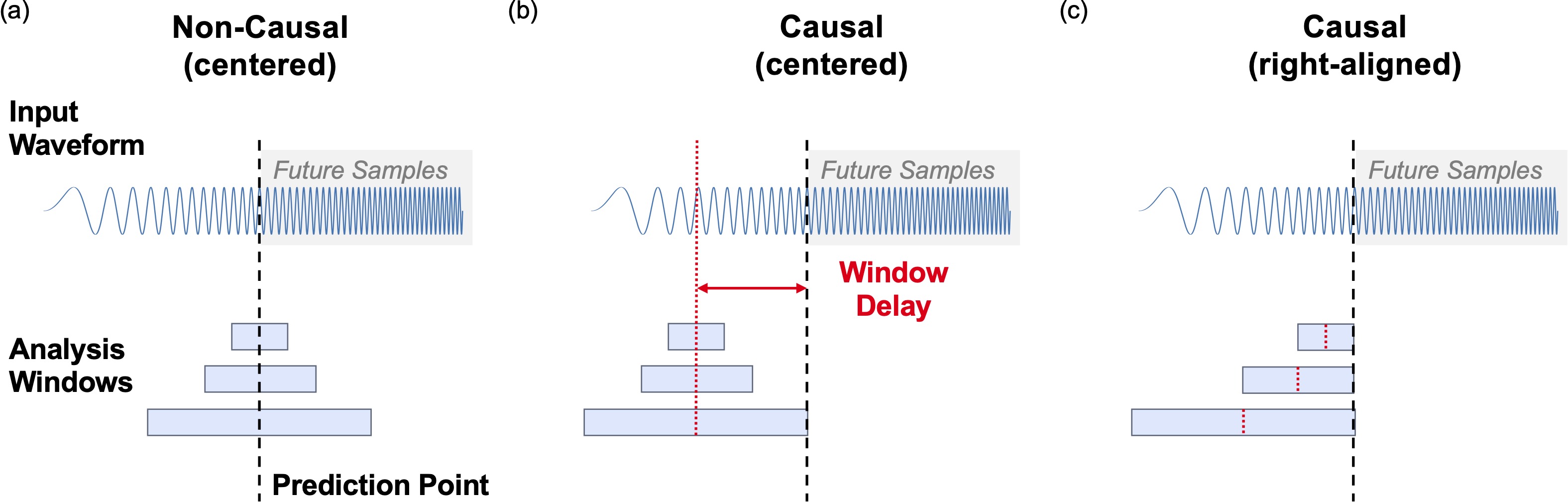
Pitch estimation in real time is essential for a wide range of Music Information Retrieval (MIR) applications, including intonation monitoring, music education, and interactive systems. Many of these use cases, such as ensemble rehearsal settings, require low-latency, multi-channel processing on resource-constrained devices. While recent neural approaches offer high accuracy, they often fall short in real-time performance due to computational demands. In this paper, we revisit the well-established SWIPE algorithm and introduce RT-SWIPE, a real-time variant enabled by using causal windowing. We further propose a delay-tolerant evaluation metric that extends Raw Pitch Accuracy (RPA) to account for algorithmic delays. Experimental results on synthetic signals and multi-track ensemble recordings demonstrate that RT-SWIPE provides a practical balance of latency, accuracy, and efficiency. Although our study focuses on wind orchestra scenarios, the method is broadly applicable to similar real-time settings.
Application Scenario 1: Intonation Monitoring
The first application scenario for the RT-SWIPE algorithm is a real-time intonation monitoring system [3] designed for music ensembles. This system provides immediate feedback to both musicians and conductors, enabling collaborative rehearsal practices and improved ensemble tuning. By leveraging the RT-SWIPE algorithm, the system achieves low-latency, multi-channel pitch estimation, making it suitable for resource-constrained environments.
The accompanying video demonstrates the system in action, showcasing how individual musicians receive personalized feedback on their pitch accuracy and stability in real time while playing a chorale from the ChoraleBricks [1] dataset.
For additional information, visit the accompanying website.
Application Scenario 2: Interactive Singing Game
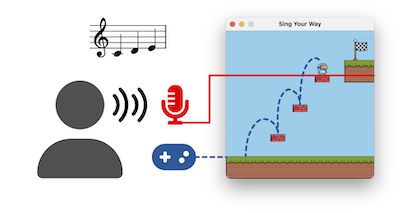
The second application scenario for the RT-SWIPE algorithm is an interactive singing game called "Sing Your Way" [4] designed to combine education and entertainment. This game challenges players to control a character in a virtual environment using their singing voice. By estimating the pitch of the player's voice in real time, the RT-SWIPE algorithm enables innovative gameplay mechanics, such as navigating through obstacles and interacting with the game world.
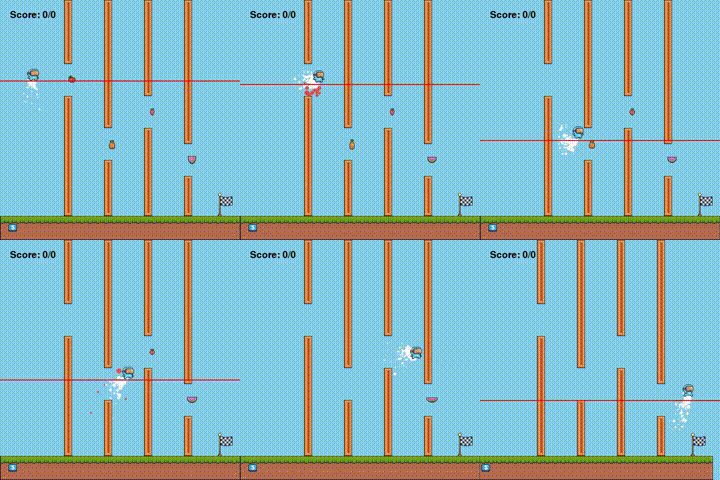
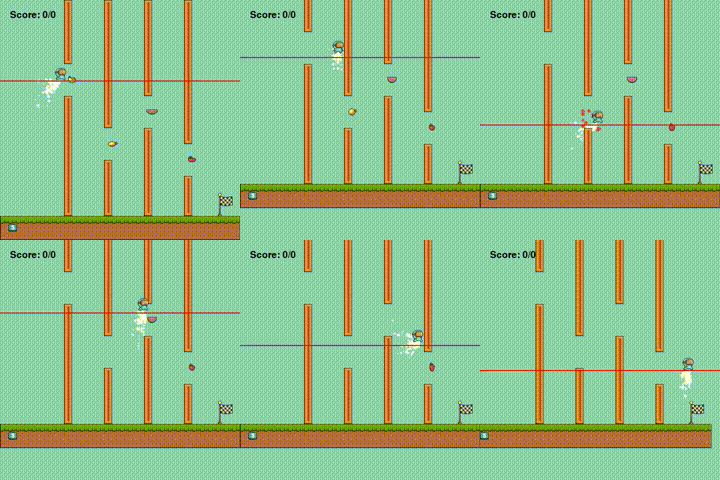
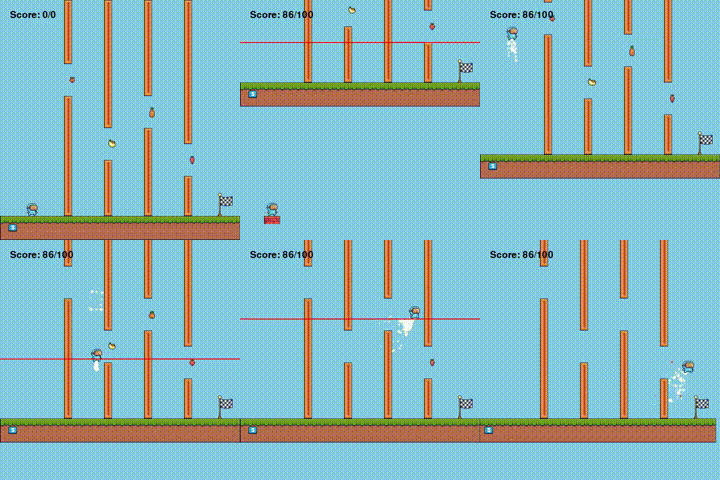
The accompanying video demonstrates Level 5 of the game, where players enter a flying mode controlled by their singing pitch. Players must smoothly transition between pitches to navigate through narrow gaps, offering a fun and engaging way to train vocal control and precision. While solving Level 5, the players might notice the famous four-note "short-short-short-long" motif from Ludwig van Beethoven's Symphony No. 5 in C minor, Op. 67.
For additional game levels, please visit the accompanying website.
Users Playing Level 5
References
- Stefan Balke, Axel Berndt, and Meinard Müller
ChoraleBricks: A Modular Multitrack Dataset for Wind Music Research
Transactions of the International Society for Music Information Retrieval (TISMIR), 2025.@article{BalkeBM24_ChoraleBricks_TISMIR, author = {Stefan Balke and Axel Berndt and Meinard M{\"u}ller}, title = {{ChoraleBricks}: A Modular Multitrack Dataset for Wind Music Research}, journal = {Transactions of the International Society for Music Information Retrieval ({TISMIR})}, year = {2025} } - Peter Meier, Meinard Müller, and Stefan Balke
Analyzing Pitch Estimation Accuracy in Cross-Talk Scenarios: A Study with Wind Instruments
In Proceedings of the Sound and Music Computing Conference (SMC): 3–10, 2025. PDF Details Demo DOI@inproceedings{MeierMB25_PitchCrosstalkChoraleBricks_SMC, author = {Peter Meier and Meinard M{\"u}ller and Stefan Balke}, title = {Analyzing Pitch Estimation Accuracy in Cross-Talk Scenarios: {A} Study with Wind Instruments}, booktitle = {Proceedings of the Sound and Music Computing Conference ({SMC})}, address = {Graz, Austria}, year = {2025}, pages = {3--10}, doi = {10.5281/zenodo.15835032}, url-pdf = {2025_MeierMB_WindPitchEstimation_SMC.pdf}, url-demo = {https://www.audiolabs-erlangen.de/resources/MIR/2025-SMC-PitchCrosstalk}, url-details = {https://zenodo.org/records/15835033} } - Peter Meier, Meinard Müller, and Stefan Balke
A Multi-User Interface for Real-Time Intonation Monitoring in Music Ensembles
In Proceedings of the Workshop for Innovative Computer-based Music Interfaces (ICMI), 2025. Details DOI@inproceedings{MeierMB25_IntonationMonitoring_ICMI, author = {Peter Meier and Meinard M{\"u}ller and Stefan Balke}, title = {A Multi-User Interface for Real-Time Intonation Monitoring in Music Ensembles}, booktitle = {Proceedings of the Workshop for Innovative Computer-based Music Interfaces ({ICMI})}, address = {Chemnitz, Germany}, year = {2025}, doi = {10.18420/muc2025-mci-ws06-202}, url-details = {https://www.audiolabs-erlangen.de/resources/MIR/2025-ICMI-Intonation} } - Peter Meier, Simon Schwär, Gerhard Krump, and Meinard Müller
Evaluating Real-Time Pitch Estimation Algorithms for Creative Music Game Interaction
In: INFORMATIK 2023 — Designing Futures: Zukünfte gestalten, Gesellschaft für Informatik e.V.: 873–882, 2023. DOI@incollection{MeierSKM23_EvaluatingPitchGame_GI, author = {Peter Meier and Simon Schw{\"a}r and Gerhard Krump and Meinard M{\"u}ller}, title = {Evaluating Real-Time Pitch Estimation Algorithms for Creative Music Game Interaction}, booktitle = {INFORMATIK 2023 -- Designing Futures: Zuk{\"u}nfte gestalten}, publisher = {Gesellschaft f{\"u}r Informatik e.V.}, address = {Bonn, Germany}, year = {2023}, doi = {10.18420/inf2023_97}, pages = {873--882} }
Acknowledgments
The International Audio Laboratories Erlangen, Germany, are a joint institution of the Friedrich-Alexander-Universität Erlangen-Nürnberg (FAU) and Fraunhofer Institute for Integrated Circuits IIS. This work was funded by the Deutsche Forschungsgemeinschaft (DFG, German Research Foundation) under grant numbers 500643750 (MU 2686/15-1) and 555525568 (MU 2686/18-1).